
BROCHURE
Contact YPT for a detailed information about YPT Scalpers.
YPT Quality Management System
For detailed information about YPT Quality Management System
YPT Process Equipment Factory
For detailed information about YPT Process Equipment Factory
First Line of Defense in Material Screening
YPT Scalpers
A Scalper—also known as a grizzly scalping screen or primary feeder scalper—is a heavy-duty mechanical separator designed to remove oversize rocks, boulders, and debris from run-of-mine (ROM) or crusher-feed material before it enters downstream crushing or screening stages.
Scalpers operate as the first step of mineral-processing circuits to protect crushers, improve throughput consistency, and enhance overall plant efficiency
They are often integrated with vibrating feeders or grizzly decks and are engineered to handle large rock lumps (sometimes exceeding 1 m in diameter) and high-impact loading.
Scalpers operate as the first step of mineral-processing circuits to protect crushers, improve throughput consistency, and enhance overall plant efficiency
They are often integrated with vibrating feeders or grizzly decks and are engineered to handle large rock lumps (sometimes exceeding 1 m in diameter) and high-impact loading.

Areas of Application
Scalpers are installed wherever feed material must be sized or cleaned before primary crushing:
Principle of Operation

Remove the Fines, Protect the Downstream...
YPT Scalpers Highlights


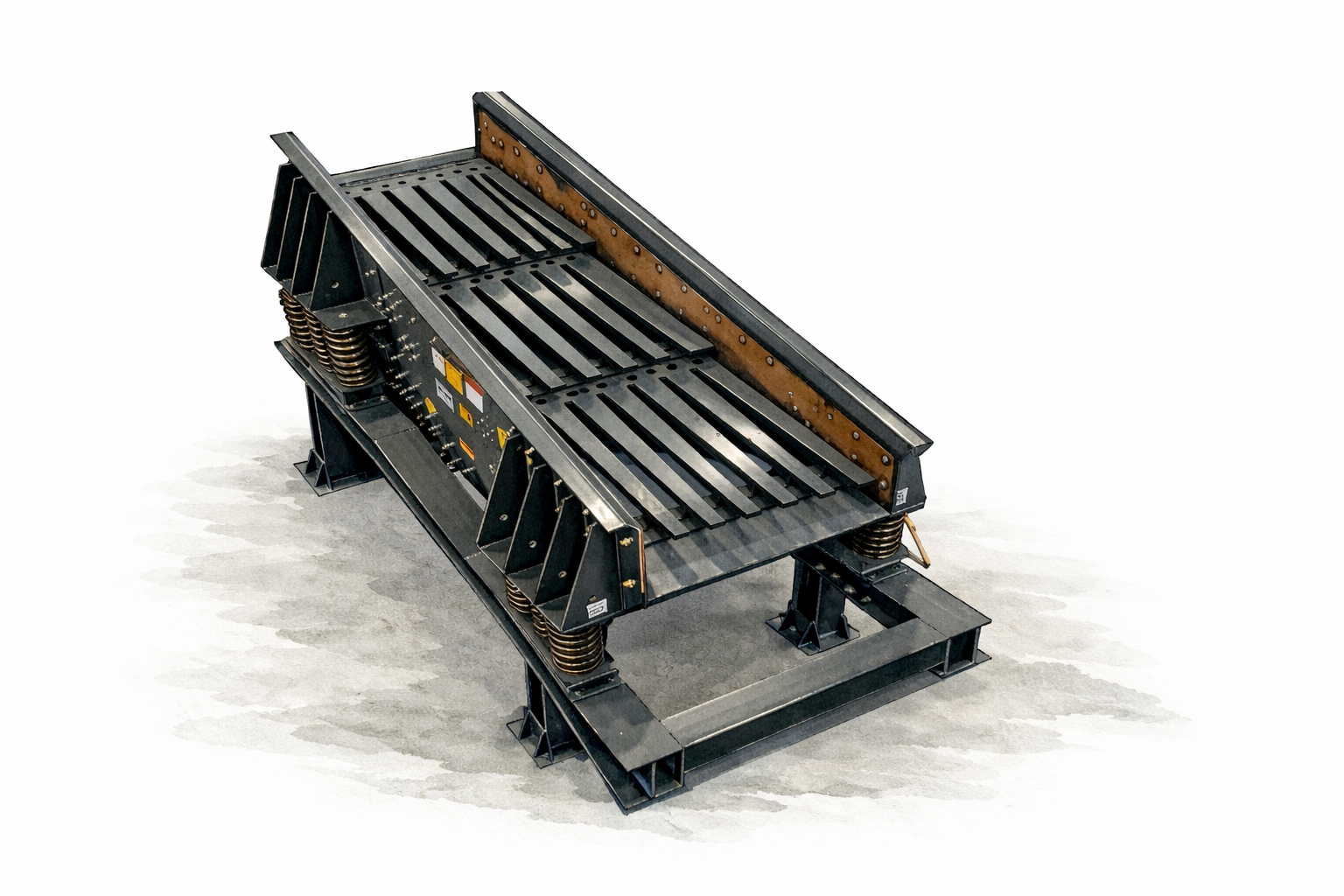

Remove the Fines, Protect the Downstream...
Design Criteria
Capacity: | up to 3000 t/h for large mining scalpers. |
Feed size: | up to 1200 mm lump size for heavy-duty models. |
Deck | 5–20°, optimized for flow and separation efficiency. |
Drive | twin unbalanced motors, exciter gearbox, or eccentric shaft drive. |
Screening | steel grizzly bars (for primary crushing), or rubber/polyurethane panels for finer separation. |
Structural | fully welded or bolted, abrasion-resistant liners, heavy-duty side plates, cross-members, and damping springs. |
Maintenance | replaceable wear liners, easy motor alignment, hydraulic lifting for screen change-out. |
Environmental | designed for wet, sticky, or frozen feed; heating or washing options can be integrated. |


Technical Specifications
Max | 600 – 1200 mm | Lump size before primary crusher |
Deck | 5° – 20° | Steeper angles for sticky material |
Stroke | 5 – 12 mm | Adjusted via eccentric weights |
Vibration | 600 – 1000 RPM | Depends on motor type |
Grizzly | 75 – 250 mm | Sized to desired bypass fraction |
Drive | 15 – 75 kW | Depending on machine size |
Construction | AR steel / HSLA plates | Wear-resistant and reinforced |
Operating | –20 °C – +60 °C | With heaters for cold climates |
Important Considerations:
