
BROCHURE
Contact YPT for a detailed information about YPT CP SERIES CARBON PUMPS.
YPT Quality Management System
For detailed information about YPT Quality Management System
YPT POMPA Slurry Pumps Factory
For detailed information about YPT POMPA Slurry Pumps Factory
Efficient carbon transfer with non-clogging flow behavior
YPT CP SERIES — CARBON PUMPS
The CP Series is engineered for carbon transfer and demanding solids-handling duties where blockage risk and material damage must be minimized.
Its hydraulic concept combines a screw-type conveying action with a centrifugal stage so flow remains stable even when solids content is high.
The internal flow path is designed to be smooth and open, helping large soft solids pass without abrupt direction changes.
This makes the pump a strong fit when the process value depends on preserving particle integrity and avoiding fragmentation. Selection typically prioritizes stable transfer, non-clogging behavior, and predictable performance across a practical duty range.
Its hydraulic concept combines a screw-type conveying action with a centrifugal stage so flow remains stable even when solids content is high.
The internal flow path is designed to be smooth and open, helping large soft solids pass without abrupt direction changes.
This makes the pump a strong fit when the process value depends on preserving particle integrity and avoiding fragmentation. Selection typically prioritizes stable transfer, non-clogging behavior, and predictable performance across a practical duty range.


Carbon transfer without plugging and attrition
Typical duties
CP pumps are chosen when the duty includes soft, bulky, or fragile solids that can be damaged or blocked in conventional slurry pumps.
These duties often run continuously and are tied to metallurgical performance, so interruptions and unstable flow create immediate operational and recovery impacts.
Carbon transfer is a classic example because media attrition, breakage, and plugging can increase downstream losses and complicate circuit control.
The same logic applies in industrial services where fibrous or deformable solids must move reliably without shredding or clogging.
CP is therefore positioned for the following duty families where stable, non-clogging solids transport is critical.
These duties often run continuously and are tied to metallurgical performance, so interruptions and unstable flow create immediate operational and recovery impacts.
Carbon transfer is a classic example because media attrition, breakage, and plugging can increase downstream losses and complicate circuit control.
The same logic applies in industrial services where fibrous or deformable solids must move reliably without shredding or clogging.
CP is therefore positioned for the following duty families where stable, non-clogging solids transport is critical.
Screw + centrifugal concept for stability
Core design features
The CP Series is built around a hydraulic philosophy that prioritizes stable solids conveyance first, then efficient head generation second.
In many solids duties, conventional impellers can overload, clog, or create intense local shear that damages the carried material.
CP addresses this by using a screw-driven intake behavior that encourages consistent pickup and forward movement of solids instead of forcing abrupt recirculation.
The pump is also intended to remain stable across a broad duty range so operators can handle process variability without operating “on the edge.”
The resulting platform is typically selected to reduce clogging events, protect sensitive media, and keep operation predictable under variable solids loading.
In many solids duties, conventional impellers can overload, clog, or create intense local shear that damages the carried material.
CP addresses this by using a screw-driven intake behavior that encourages consistent pickup and forward movement of solids instead of forcing abrupt recirculation.
The pump is also intended to remain stable across a broad duty range so operators can handle process variability without operating “on the edge.”
The resulting platform is typically selected to reduce clogging events, protect sensitive media, and keep operation predictable under variable solids loading.

Convey solids smoothly, then build head
Principle of Operation
CP can be understood as a two-stage action inside one pump: a screw-like conveying section followed by a centrifugal head-producing section.
The screw element initiates flow by “gripping” and moving dense slurry in a controlled manner, helping the pump keep feeding even when solids content is high.
Once the flow is established, the centrifugal section builds head and supports stable discharge behavior across a wide operating range.
Because the solids are guided through a smooth, open channel, the flow experiences fewer abrupt turns and less mechanical stress than in many standard impeller passages.
The practical outcome is a pump that keeps moving soft, bulky, or fragile solids reliably while maintaining high hydraulic efficiency for the duty.
The screw element initiates flow by “gripping” and moving dense slurry in a controlled manner, helping the pump keep feeding even when solids content is high.
Once the flow is established, the centrifugal section builds head and supports stable discharge behavior across a wide operating range.
Because the solids are guided through a smooth, open channel, the flow experiences fewer abrupt turns and less mechanical stress than in many standard impeller passages.
The practical outcome is a pump that keeps moving soft, bulky, or fragile solids reliably while maintaining high hydraulic efficiency for the duty.
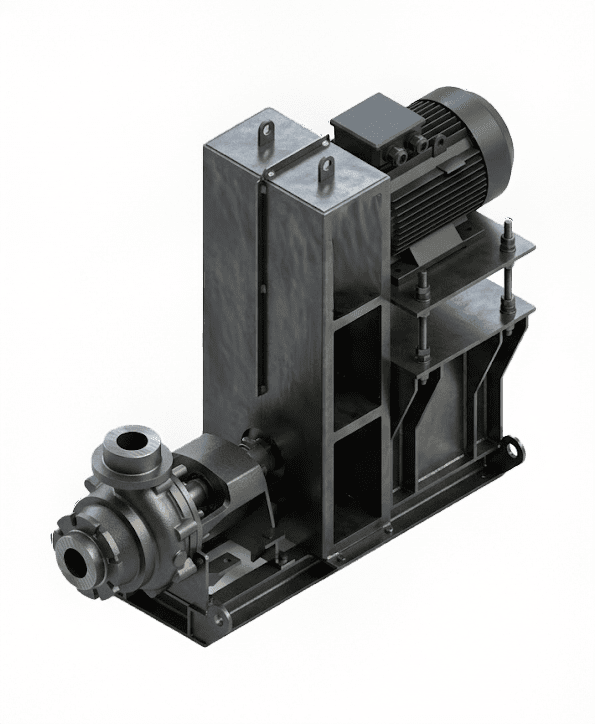
Hard-metal wear control for high-solids duty
Wet-end & wear material
Even in “soft-solids” duties, wear can still be significant because solids content can be high and local velocities can create erosion over time.
CP uses a hard-metal wear strategy to maintain predictable erosion resistance and to keep internal clearances stable as service hours accumulate.
This approach also supports repeatable rebuild work because wear behavior is more consistent and parts selection is simpler.
Wear planning should still consider duty specifics such as particle size, solids concentration swings, and whether any sharp abrasives are present alongside the soft solids.
The best lifecycle cost is typically achieved by matching the wear package to the expected worst-case duty and then operating within a defined speed and solids window.
CP uses a hard-metal wear strategy to maintain predictable erosion resistance and to keep internal clearances stable as service hours accumulate.
This approach also supports repeatable rebuild work because wear behavior is more consistent and parts selection is simpler.
Wear planning should still consider duty specifics such as particle size, solids concentration swings, and whether any sharp abrasives are present alongside the soft solids.
The best lifecycle cost is typically achieved by matching the wear package to the expected worst-case duty and then operating within a defined speed and solids window.

Housekeeping-ready reliability for carbon areas
Sealing concept
In carbon and soft-solids transfer, sealing selection is often driven by housekeeping, leakage expectations, and how strictly water addition must be controlled.
Plants may want to minimize dilution while still maintaining a reliable, serviceable sealing arrangement that operators can manage consistently.
Because solids content can be high, the sealing approach must also tolerate occasional variability without becoming overly sensitive to short-term upsets.
The most reliable outcome usually comes from choosing a sealing package that matches site maintenance capability and then enforcing a clear operating discipline around inspection and adjustment.
For project delivery, sealing should be finalized together with duty point confirmation so performance, wear strategy, and reliability targets align.
Plants may want to minimize dilution while still maintaining a reliable, serviceable sealing arrangement that operators can manage consistently.
Because solids content can be high, the sealing approach must also tolerate occasional variability without becoming overly sensitive to short-term upsets.
The most reliable outcome usually comes from choosing a sealing package that matches site maintenance capability and then enforcing a clear operating discipline around inspection and adjustment.
For project delivery, sealing should be finalized together with duty point confirmation so performance, wear strategy, and reliability targets align.


Models & outline dimensions
CP installations are typically selected with layout practicality in mind because carbon systems often sit in congested plant areas with strict access and safety constraints.
Dimensions are important early because they influence baseplate sizing, lifting clearances, and how the pump is integrated with carbon transfer piping.
Weight matters for maintenance handling, especially when routine inspection and change-out must be completed quickly during planned shutdown windows.
The connection sizes should also be checked against site piping standards to avoid unnecessary reducers and local losses that can destabilize transfer.
Use the table below as a starting point for footprint planning, then confirm final GA details during engineering.
Dimensions are important early because they influence baseplate sizing, lifting clearances, and how the pump is integrated with carbon transfer piping.
Weight matters for maintenance handling, especially when routine inspection and change-out must be completed quickly during planned shutdown windows.
The connection sizes should also be checked against site piping standards to avoid unnecessary reducers and local losses that can destabilize transfer.
Use the table below as a starting point for footprint planning, then confirm final GA details during engineering.

Model | Inlet | Outlet | H | L | W | Bare |
|---|---|---|---|---|---|---|
CP 95×80 | 95 | 80 | 431 | 672 | 341 | 87 |
RFQ / sizing inputs
A correct CP selection depends on understanding not only the duty point, but also the solids nature and the “damage sensitivity” of the carried material.
Two duties with the same flow can behave very differently if one carries activated carbon with strict attrition limits and the other carries fibrous solids with a blockage risk.
It is important to define the expected solids range (normal and upset), because these pumps are often chosen specifically to handle high-solids variability without clogging.
Discharge routing should be described clearly, since long lines, elevation changes, and control valves can dominate the head requirement and influence stability.
With the inputs below, the pump can be sized with realistic margins and the configuration can be locked faster for drawings, spares, and commissioning.
