
BROCHURE
Contact YPT for a detailed information about YPT DT SERIES TANK PUMPS.
YPT Quality Management System
For detailed information about YPT Quality Management System
YPT POMPA Slurry Pumps Factory
For detailed information about YPT POMPA Slurry Pumps Factory
YPT DT SERIES — VERTICAL TANK PUMPS
Vertical tank pumping for abrasive slurry duty
The DT Series is a vertical tank pump platform intended for abrasive slurry handling in process areas where reliability and straightforward upkeep matter.
It is commonly applied where tank-mounted pumping, compact footprint, and practical access are needed around process equipment.
The design prioritizes stable operation in duties that may carry entrained air and experience variable slurry behavior.
DT pumps are often chosen to reduce maintenance complexity by avoiding seal-water dependency and submerged components that are difficult to service. Selection typically balances duty point, solids loading, and how the pump integrates into plant layout and operating discipline.
It is commonly applied where tank-mounted pumping, compact footprint, and practical access are needed around process equipment.
The design prioritizes stable operation in duties that may carry entrained air and experience variable slurry behavior.
DT pumps are often chosen to reduce maintenance complexity by avoiding seal-water dependency and submerged components that are difficult to service. Selection typically balances duty point, solids loading, and how the pump integrates into plant layout and operating discipline.

Tank-mounted transfer for process stability
Typical duties
DT pumps are typically installed in plant areas where slurry is collected in a tank or sump-like vessel and must be transferred onward without complicated auxiliary systems.
These duties often sit close to screening, classification, or process transfer points where the slurry stream can carry entrained air, splashing, and moderate solids variability.
Operators usually want a pump that starts reliably, tolerates intermittent conditions, and stays predictable even when the tank level or feed behavior changes.
Because the pump is vertical and tank-mounted, it is frequently selected where floor space is limited or where a wet-end must sit directly in a tank. DT is therefore a practical choice for the following duty families.
These duties often sit close to screening, classification, or process transfer points where the slurry stream can carry entrained air, splashing, and moderate solids variability.
Operators usually want a pump that starts reliably, tolerates intermittent conditions, and stays predictable even when the tank level or feed behavior changes.
Because the pump is vertical and tank-mounted, it is frequently selected where floor space is limited or where a wet-end must sit directly in a tank. DT is therefore a practical choice for the following duty families.
Vertical inlet concept to resist air blocking
Core design features
Vertical tank pumps must remain stable even when the incoming stream is not perfectly “pump-friendly,” so DT focuses on predictable behavior under demanding, real plant conditions.
A key challenge in tank pumping is air management; if air accumulates at the wrong location, conventional designs can lose performance or become difficult to control.
DT uses a vertical wet-end inlet concept that helps prevent air-blocking by giving entrained air a natural path upward rather than trapping it in the suction zone.
The platform is also intended to be robust and streamlined so it can operate in abrasive slurry environments without needing delicate adjustments.
For duty matching, the series offers two impeller styles so the hydraulic behavior can be tuned to the service.
A key challenge in tank pumping is air management; if air accumulates at the wrong location, conventional designs can lose performance or become difficult to control.
DT uses a vertical wet-end inlet concept that helps prevent air-blocking by giving entrained air a natural path upward rather than trapping it in the suction zone.
The platform is also intended to be robust and streamlined so it can operate in abrasive slurry environments without needing delicate adjustments.
For duty matching, the series offers two impeller styles so the hydraulic behavior can be tuned to the service.
...
Wear options aligned to abrasive tank duty
Wet-end & wear material
Abrasive tank duties can wear rapidly if material strategy is not aligned with solids behavior, so DT selections should start with wear mode and slurry variability.
In many tank services, erosion dominates due to velocity and turbulence, while some applications may see additional impact wear from coarse particles.
DT can be configured with a hard metal wear path suited to abrasive slurries where predictable erosion resistance is required.
For selected duty profiles, elastomer wear parts may also be preferred where resilience improves wear life and reduces sensitivity to certain wear patterns.
The practical objective is to set a wear strategy that supports a stable maintenance interval and a simple spares plan, rather than chasing maximum life in one component at the expense of overall reliability.
In many tank services, erosion dominates due to velocity and turbulence, while some applications may see additional impact wear from coarse particles.
DT can be configured with a hard metal wear path suited to abrasive slurries where predictable erosion resistance is required.
For selected duty profiles, elastomer wear parts may also be preferred where resilience improves wear life and reduces sensitivity to certain wear patterns.
The practical objective is to set a wear strategy that supports a stable maintenance interval and a simple spares plan, rather than chasing maximum life in one component at the expense of overall reliability.


Run-dry philosophy with simplified sealing
Sealing
In tank services, sealing is often an operational headache because slurry splash, entrained air, and variable levels can challenge conventional seal arrangements.
DT is positioned to reduce that complexity by avoiding submerged sealing elements that require frequent attention and supporting operation without a continuous seal-water supply.
Eliminating seal-water dependency is valuable in plants that want tighter water discipline, fewer utility connections, and less housekeeping around gland leaks.
A simplified sealing philosophy also helps reliability because fewer slurry-exposed sealing interfaces generally means fewer failure modes in abrasive environments.
The run-dry capability intent further supports practical operations during level fluctuations, intermittent feed, or brief upset scenarios.
DT is positioned to reduce that complexity by avoiding submerged sealing elements that require frequent attention and supporting operation without a continuous seal-water supply.
Eliminating seal-water dependency is valuable in plants that want tighter water discipline, fewer utility connections, and less housekeeping around gland leaks.
A simplified sealing philosophy also helps reliability because fewer slurry-exposed sealing interfaces generally means fewer failure modes in abrasive environments.
The run-dry capability intent further supports practical operations during level fluctuations, intermittent feed, or brief upset scenarios.
Easy access planning for busy process areas
Maintenance & serviceability
Tank-mounted pumps often sit in busy areas with limited access, so DT installations should be planned for predictable, repeatable service work.
The most effective maintenance approach is to treat wear parts as routine change items and schedule inspections based on wear progression rather than fixed time alone.
Because abrasive duties can drift as solids concentration changes, tracking performance indicators (flow/head response, vibration trend, power draw changes) helps time interventions before a failure forces downtime.
Service planning should also consider safe lifting and removal paths, because vertical pumps can require careful handling during wet-end work. When spares are standardized and rebuild steps are documented, DT pumps become easier to operate consistently across multiple sites and crews.
The most effective maintenance approach is to treat wear parts as routine change items and schedule inspections based on wear progression rather than fixed time alone.
Because abrasive duties can drift as solids concentration changes, tracking performance indicators (flow/head response, vibration trend, power draw changes) helps time interventions before a failure forces downtime.
Service planning should also consider safe lifting and removal paths, because vertical pumps can require careful handling during wet-end work. When spares are standardized and rebuild steps are documented, DT pumps become easier to operate consistently across multiple sites and crews.


Models & outline dimensions
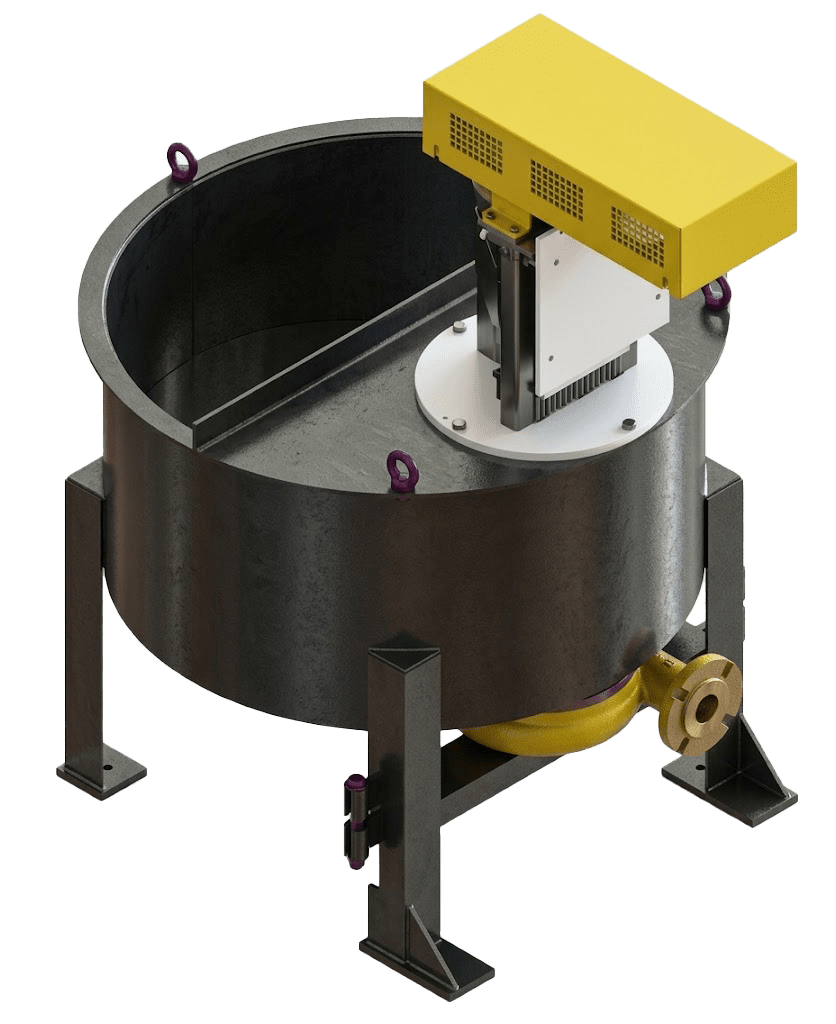
DT pumps are often selected early in layout because their footprint, height, and tank integration influence platforms, access ladders, and maintenance clearances.
Outline dimensions support civil and structural planning, especially where flotation buildings, process galleries, or tank farms have tight space. Total weight affects lifting plans, platform load ratings, and maintenance tooling selection.
Tank volume is a practical indicator of how the system buffers incoming flow variability and supports stable tank duty operation.
Use the table below for early layout planning, then confirm final GA details with motor/base, discharge routing, and site constraints..
Outline dimensions support civil and structural planning, especially where flotation buildings, process galleries, or tank farms have tight space. Total weight affects lifting plans, platform load ratings, and maintenance tooling selection.
Tank volume is a practical indicator of how the system buffers incoming flow variability and supports stable tank duty operation.
Use the table below for early layout planning, then confirm final GA details with motor/base, discharge routing, and site constraints..

Model | Outlet | H | L | W | Total | Tank |
|---|---|---|---|---|---|---|
DT50 | 50 | 920 | 920 | 1460 | 300 | 0,245 |
DT80 | 80 | 951 | 951 | 1894 | 600 | 0,33 |
RFQ / sizing inputs
A correct DT selection depends on understanding both the duty point and the tank conditions that drive real-world behavior.
Two duties with the same average flow can require different choices because entrained air, level variation, and intermittent feed can change pumpability and stability.
It is important to define the expected operating range, not only the “normal” point, and to describe any upset scenarios such as surging inflow or level swings.
If solids behavior changes through the shift, wear strategy and impeller configuration should be chosen to maintain predictable performance rather than short-term peak output.
With the inputs below, the pump can be sized with realistic margins and the configuration can be locked quickly for drawings, spares, and commissioning.