
BROCHURE
Contact YPT for a detailed information about YPT MTH SERIES SLURRY PUMPS .
YPT Quality Management System
For detailed information about YPT Quality Management System
YPT POMPA Slurry Pumps Factory
For detailed information about YPT POMPA Slurry Pumps Factory
High head delivery for long-distance slurry transport
YPT MTH SERIES — HIGH-HEAD HORIZONTAL SLURRY PUMPS
The MTH Series is designed for applications where high head is the primary requirement and the pumping duty is severe in terms of pressure and wear.
It is commonly selected when long discharge lines, elevation gain, or staged pumping requires a head-capable slurry platform.
The series is built around a large-diameter impeller concept and a casing arrangement aimed at controlling hydraulic turbulence and wear distribution.
In practice, MTH is used where the pump must hold head consistently over time, even as wear develops. The result is a duty-oriented solution intended for demanding tailings and refuse services.
It is commonly selected when long discharge lines, elevation gain, or staged pumping requires a head-capable slurry platform.
The series is built around a large-diameter impeller concept and a casing arrangement aimed at controlling hydraulic turbulence and wear distribution.
In practice, MTH is used where the pump must hold head consistently over time, even as wear develops. The result is a duty-oriented solution intended for demanding tailings and refuse services.
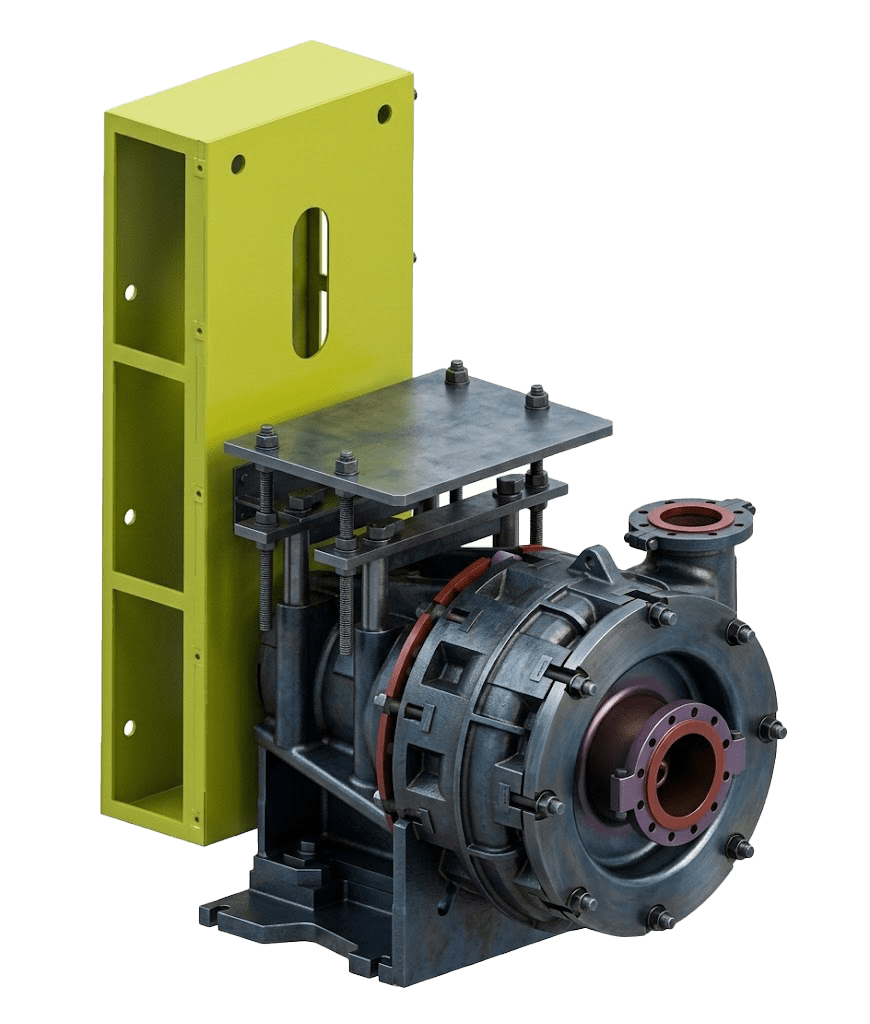
High-head duty for long lines and lifts
Typical duties
MTH is typically used in mine services where the slurry route is long, the static lift can be significant, or the discharge pressure is intentionally high.
These circuits often operate continuously and are tied to plant availability, so stability and predictability matter more than short-term peak performance.
Because tailings and refuse duties can vary in solids concentration and particle size, the pump must tolerate changes without becoming difficult to control.
Many sites also require a conservative operating approach because shutdowns and restarts can stress pipelines and mechanical systems.
For these reasons, MTH is most commonly positioned in the following duty family.
These circuits often operate continuously and are tied to plant availability, so stability and predictability matter more than short-term peak performance.
Because tailings and refuse duties can vary in solids concentration and particle size, the pump must tolerate changes without becoming difficult to control.
Many sites also require a conservative operating approach because shutdowns and restarts can stress pipelines and mechanical systems.
For these reasons, MTH is most commonly positioned in the following duty family.
Large-impeller concept for pressure stability
Core design features
High-head slurry pumping is largely a balance between hydraulic capability, mechanical loading, and wear stability over time.
The MTH platform is built around a larger impeller diameter concept intended to support higher pressures while keeping performance stable.
A key design intent is to achieve high head while operating at comparatively slower speeds, which can help reduce wear rates and protect suction behavior in difficult services.
The casing and impeller are configured to reduce hydraulic turbulence so wear tends to distribute more evenly rather than concentrating in a single hotspot.
The casing arrangement is also structured to support longer wear life and practical wear management during rebuild cycles.
The MTH platform is built around a larger impeller diameter concept intended to support higher pressures while keeping performance stable.
A key design intent is to achieve high head while operating at comparatively slower speeds, which can help reduce wear rates and protect suction behavior in difficult services.
The casing and impeller are configured to reduce hydraulic turbulence so wear tends to distribute more evenly rather than concentrating in a single hotspot.
The casing arrangement is also structured to support longer wear life and practical wear management during rebuild cycles.

Hard-metal wear path for severe head service
Wet-end & wear material options
In high-head slurry duty, wear is often accelerated by velocity and pressure-driven turbulence, so the wet-end material strategy needs to be conservative.
The MTH Series follows a hard-metal wear philosophy and is offered only with high-chrome wear parts for abrasion resistance in severe services.
This simplifies configuration selection and helps standardize spares, especially where the site wants a consistent alloy approach across critical duty pumps.
Even with a robust alloy, practical wear life still depends on operating speed selection, solids concentration, and particle sharpness.
The best results are achieved when material selection, speed, and operating window are treated as a single package rather than separate decisions.
The MTH Series follows a hard-metal wear philosophy and is offered only with high-chrome wear parts for abrasion resistance in severe services.
This simplifies configuration selection and helps standardize spares, especially where the site wants a consistent alloy approach across critical duty pumps.
Even with a robust alloy, practical wear life still depends on operating speed selection, solids concentration, and particle sharpness.
The best results are achieved when material selection, speed, and operating window are treated as a single package rather than separate decisions.
High-Chrome (HC) | wet-end as the standard and only wear material approach |


Sealing selected for pressure-driven reliability
Sealing options
Sealing selection in high-head slurry pumping directly affects reliability, housekeeping, and how much additional water enters the process.
In tailings and refuse services, plants often want robust sealing that can tolerate fluctuations in solids and occasional transients without becoming overly sensitive.
Packing arrangements are widely used in slurry duty because they are serviceable and forgiving when managed with a disciplined flushing practice.
Mechanical seals can be applied where leakage control or water restrictions are the dominant drivers, provided the duty and maintenance support are suitable.
The correct approach is to define water availability, dilution tolerance, and maintenance strategy early, then lock the sealing package during final selection.
In tailings and refuse services, plants often want robust sealing that can tolerate fluctuations in solids and occasional transients without becoming overly sensitive.
Packing arrangements are widely used in slurry duty because they are serviceable and forgiving when managed with a disciplined flushing practice.
Mechanical seals can be applied where leakage control or water restrictions are the dominant drivers, provided the duty and maintenance support are suitable.
The correct approach is to define water availability, dilution tolerance, and maintenance strategy early, then lock the sealing package during final selection.
Wear-driven service planning for critical lines
Maintenance & serviceability
High-head slurry pumps are typically maintained on a wear-driven schedule, so service planning should focus on predictable change-outs and controlled downtime.
MTH duties often sit on critical transport lines, meaning maintenance windows may be constrained and must be planned around plant availability.
The most effective maintenance approach is usually to standardize wear parts, define inspection triggers, and keep rebuild work repeatable across the fleet.
Because high-head pumps can carry higher mechanical loads, routine checks on bearings, alignment, and vibration trends become especially important.
A practical spares and rebuild plan is therefore as valuable as the pump selection itself.
MTH duties often sit on critical transport lines, meaning maintenance windows may be constrained and must be planned around plant availability.
The most effective maintenance approach is usually to standardize wear parts, define inspection triggers, and keep rebuild work repeatable across the fleet.
Because high-head pumps can carry higher mechanical loads, routine checks on bearings, alignment, and vibration trends become especially important.
A practical spares and rebuild plan is therefore as valuable as the pump selection itself.


Models & outline dimensions
MTH sizing typically starts from the head requirement and then confirms the practical envelope needed for installation and maintenance access.
Outline dimensions are most useful at the layout stage because they influence foundation design, lifting selection, and safe service clearances.
Bare-shaft weight is a practical parameter for crane planning and workshop handling, especially when the pump is treated as a critical asset in a high-head line.
Because high-head duties are sensitive to operating speed and wear, final package details should be confirmed with the selected speed, motor/base arrangement, and site constraints.
Use the table below as a layout starting point, then finalize GA and interfaces during engineering.
Outline dimensions are most useful at the layout stage because they influence foundation design, lifting selection, and safe service clearances.
Bare-shaft weight is a practical parameter for crane planning and workshop handling, especially when the pump is treated as a critical asset in a high-head line.
Because high-head duties are sensitive to operating speed and wear, final package details should be confirmed with the selected speed, motor/base arrangement, and site constraints.
Use the table below as a layout starting point, then finalize GA and interfaces during engineering.

Model: | Inlet | Outlet | H | L | W | Bare |
|---|---|---|---|---|---|---|
MTH 6/4 | 150 | 100 | 1000 | 1465 | 830 | 1470 |
MTH 8/6 | 200 | 150 | 1020 | 1505 | 830 | 1610 |
RFQ / sizing inputs
Selecting a high-head slurry pump is as much about the operating envelope as it is about the nominal duty point.
Two sites with the same flow and head can require different configurations depending on solids concentration, PSD, suction conditions, and how stable the duty is over time.
Long-distance lines introduce additional considerations such as transients, pipeline friction uncertainty, and the operational impact of wear-driven performance drift.
If staged pumping is used, it is important to describe how pumps are arranged and controlled so the selection supports stable system operation. Providing the inputs below allows the duty point, speed, and wear strategy to be set realistically from the beginning.