
BROCHURE
Contact YPT for a detailed information about YPT DK SERIES FROTH PUMPS.
YPT Quality Management System
For detailed information about YPT Quality Management System
YPT POMPA Slurry Pumps Factory
For detailed information about YPT POMPA Slurry Pumps Factory
High-performance slurry pumping, engineered for real mine duties
YPT DK SERIES — FROTH PUMPS
Stable froth pumping for flotation duty streams
The DK Series is a dedicated froth-pumping platform developed for flotation circuits where air-entrainment can destabilize conventional centrifugal pumps.
In these duties, the objective is not only to move slurry, but to keep flow stable while managing a high air fraction.
DK systems are typically installed at froth launders or froth transfer points and are sized to avoid air locking and performance collapse.
The series is built around a tank-based concept that supports smooth operation at high capacities. Selection focuses on air behavior, solids loading, and how the pump integrates with flotation control.
In these duties, the objective is not only to move slurry, but to keep flow stable while managing a high air fraction.
DK systems are typically installed at froth launders or froth transfer points and are sized to avoid air locking and performance collapse.
The series is built around a tank-based concept that supports smooth operation at high capacities. Selection focuses on air behavior, solids loading, and how the pump integrates with flotation control.

Froth transfer stability for flotation circuits
Typical duties
Froth duty behaves differently from “normal slurry duty” because air is intentionally present and its fraction can change rapidly with reagent dosing, froth depth, and cell operating setpoints.
In real concentrators, the froth stream can be intermittent, highly aerated, and sensitive to backpressure, so the pump must remain tolerant to changes without constant operator intervention.
A froth pump is often located in congested flotation areas, which makes access, splash control, and housekeeping important.
The duty also tends to be process-critical: when froth transfer becomes unstable, downstream thickening and filtration can feel the impact quickly.
DK is therefore positioned where air-entrained slurry must be pumped reliably and consistently.
In real concentrators, the froth stream can be intermittent, highly aerated, and sensitive to backpressure, so the pump must remain tolerant to changes without constant operator intervention.
A froth pump is often located in congested flotation areas, which makes access, splash control, and housekeeping important.
The duty also tends to be process-critical: when froth transfer becomes unstable, downstream thickening and filtration can feel the impact quickly.
DK is therefore positioned where air-entrained slurry must be pumped reliably and consistently.
Tank-based air management for steady flow
Core design features
The DK concept is built around controlling the “air problem” first, then delivering stable pumping once air behavior is managed.
In froth duty, even a well-sized centrifugal pump can lose head and collapse in capacity when air accumulates in the casing or impeller eye.
DK addresses this by using a tank-and-flow arrangement that encourages air separation before the flow is discharged, so the pump behaves more predictably.
The mechanical layout is also oriented toward reliability in splashy, abrasive environments where fine solids and reagents can challenge conventional sealing and bearing arrangements.
In practice, the DK platform is selected because it remains stable when the froth quality and air fraction change during normal flotation control actions.
In froth duty, even a well-sized centrifugal pump can lose head and collapse in capacity when air accumulates in the casing or impeller eye.
DK addresses this by using a tank-and-flow arrangement that encourages air separation before the flow is discharged, so the pump behaves more predictably.
The mechanical layout is also oriented toward reliability in splashy, abrasive environments where fine solids and reagents can challenge conventional sealing and bearing arrangements.
In practice, the DK platform is selected because it remains stable when the froth quality and air fraction change during normal flotation control actions.

Separate air, then pump with confidence
Principle of Operation
Froth pumping can be understood as “two-phase management” rather than simple liquid transport, because the pump must handle a slurry containing a high volume of dispersed air.
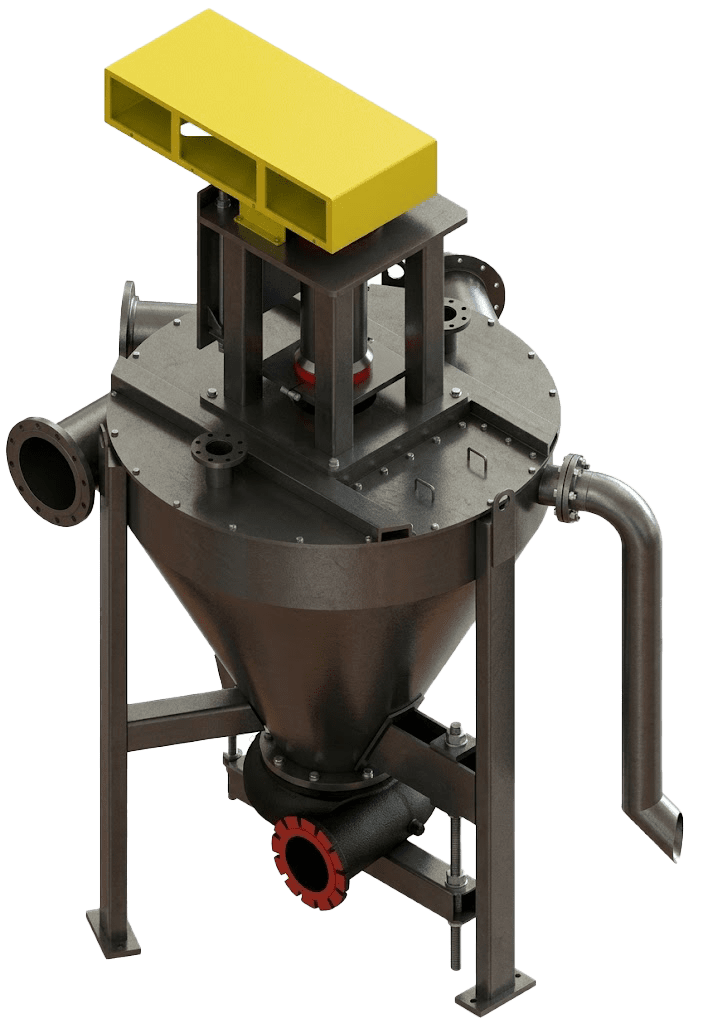
The DK system promotes air separation using a controlled vortex effect created by impeller rotation and tangential feed into a conical tank.
As air disengages, the pumped mixture becomes hydraulically “more pumpable,” which helps preserve capacity and reduce performance swings.
This approach is especially valuable when froth properties fluctuate during normal flotation operations, since the air fraction can move quickly.
The overall result is a smoother, more stable pumping response at higher capacities than standard slurry pumps typically tolerate in aerated service.
The DK system promotes air separation using a controlled vortex effect created by impeller rotation and tangential feed into a conical tank.
As air disengages, the pumped mixture becomes hydraulically “more pumpable,” which helps preserve capacity and reduce performance swings.
This approach is especially valuable when froth properties fluctuate during normal flotation operations, since the air fraction can move quickly.
The overall result is a smoother, more stable pumping response at higher capacities than standard slurry pumps typically tolerate in aerated service.

Wet-end built for abrasive, aerated duty
Wet-end & wear material
Wear in froth service is influenced by both solids abrasion and turbulence created by the aerated flow, so material strategy must be conservative.
DK pumps are typically supplied with metallic wear components suitable for abrasive flotation environments, where sharp particles and high local velocities can accelerate erosion.
Unlike many slurry duties, froth pumping also introduces unique wear patterns because the two-phase flow can change how particles impact the wet-end surfaces.
For that reason, selection should consider not only slurry SG and solids percentage, but also how stable the froth is and how often operating conditions swing.
A disciplined wear-part strategy—paired with sensible operating speed and stable discharge conditions—delivers the best lifecycle cost in froth duty.
DK pumps are typically supplied with metallic wear components suitable for abrasive flotation environments, where sharp particles and high local velocities can accelerate erosion.
Unlike many slurry duties, froth pumping also introduces unique wear patterns because the two-phase flow can change how particles impact the wet-end surfaces.
For that reason, selection should consider not only slurry SG and solids percentage, but also how stable the froth is and how often operating conditions swing.
A disciplined wear-part strategy—paired with sensible operating speed and stable discharge conditions—delivers the best lifecycle cost in froth duty.
No gland-water dependency in froth service
Sealing concept
Froth duty is often messy, chemically active, and highly aerated, so conventional gland arrangements can become a reliability and housekeeping burden. .
DK systems are designed around minimizing the need for sealing water and reducing the number of components exposed directly to the slurry. .
Eliminating gland-water demand is valuable because added water can disturb flotation water balance and can also dilute the froth stream unintentionally. .
A simplified sealing concept also reduces maintenance sensitivity: fewer sealing elements means fewer failure modes in an area where access is often difficult. .
In practice, this “no gland water” philosophy is one of the reasons froth pumps are selected as a dedicated platform rather than adapting a standard slurry pump..
DK systems are designed around minimizing the need for sealing water and reducing the number of components exposed directly to the slurry. .
Eliminating gland-water demand is valuable because added water can disturb flotation water balance and can also dilute the froth stream unintentionally. .
A simplified sealing concept also reduces maintenance sensitivity: fewer sealing elements means fewer failure modes in an area where access is often difficult. .
In practice, this “no gland water” philosophy is one of the reasons froth pumps are selected as a dedicated platform rather than adapting a standard slurry pump..


Models & outline dimensions
DK installations are typically planned around physical envelope first, because froth areas are space-constrained and require safe access around launders, platforms, and cell walkways.
The DK platform includes multiple outlet sizes so the pump can be matched to froth flow rate and plant piping standards.
Height and footprint matter not only for civil and structural design, but also for splash control and maintenance handling.
Total weight is a practical factor for lifting selection, crane planning, and safe maintenance routines, especially in flotation buildings with limited headroom.
Use the table below for early layout, then confirm final GA details with motor/base, discharge orientation, and site constraints.
The DK platform includes multiple outlet sizes so the pump can be matched to froth flow rate and plant piping standards.
Height and footprint matter not only for civil and structural design, but also for splash control and maintenance handling.
Total weight is a practical factor for lifting selection, crane planning, and safe maintenance routines, especially in flotation buildings with limited headroom.
Use the table below for early layout, then confirm final GA details with motor/base, discharge orientation, and site constraints.

Model | Outlet | H | W = L | Total | Tank |
|---|---|---|---|---|---|
DK50 | 50 | 1600 | 800 | 355 | 0,14 |
DK80 | 80 | 1000 | 1000 | 605 | 0,37 |
DK150 | 150 | 1400 | 1400 | 1095 | 0,82 |
DK250 | 250 | 1850 | 1850 | 2900 | 2,3 |
RFQ / sizing inputs
A froth pump selection must be based on how the froth behaves over time, not just one duty point.
Two circuits can share the same average flow but require different sizing because aeration, frother dosage, and froth stability change the effective pumpability dramatically.
It is especially important to describe how the froth stream varies during start-up, grade changes, or operator interventions, because those are the moments when air locking risk is highest.
Discharge line conditions should be stated clearly, since backpressure and routing can strongly influence stable froth transfer.
If you provide the inputs below, the pump can be sized with realistic margins and the final configuration can be locked faster for manufacturing and spares.